Based on our account. Vera’s commentary is her interpretation.
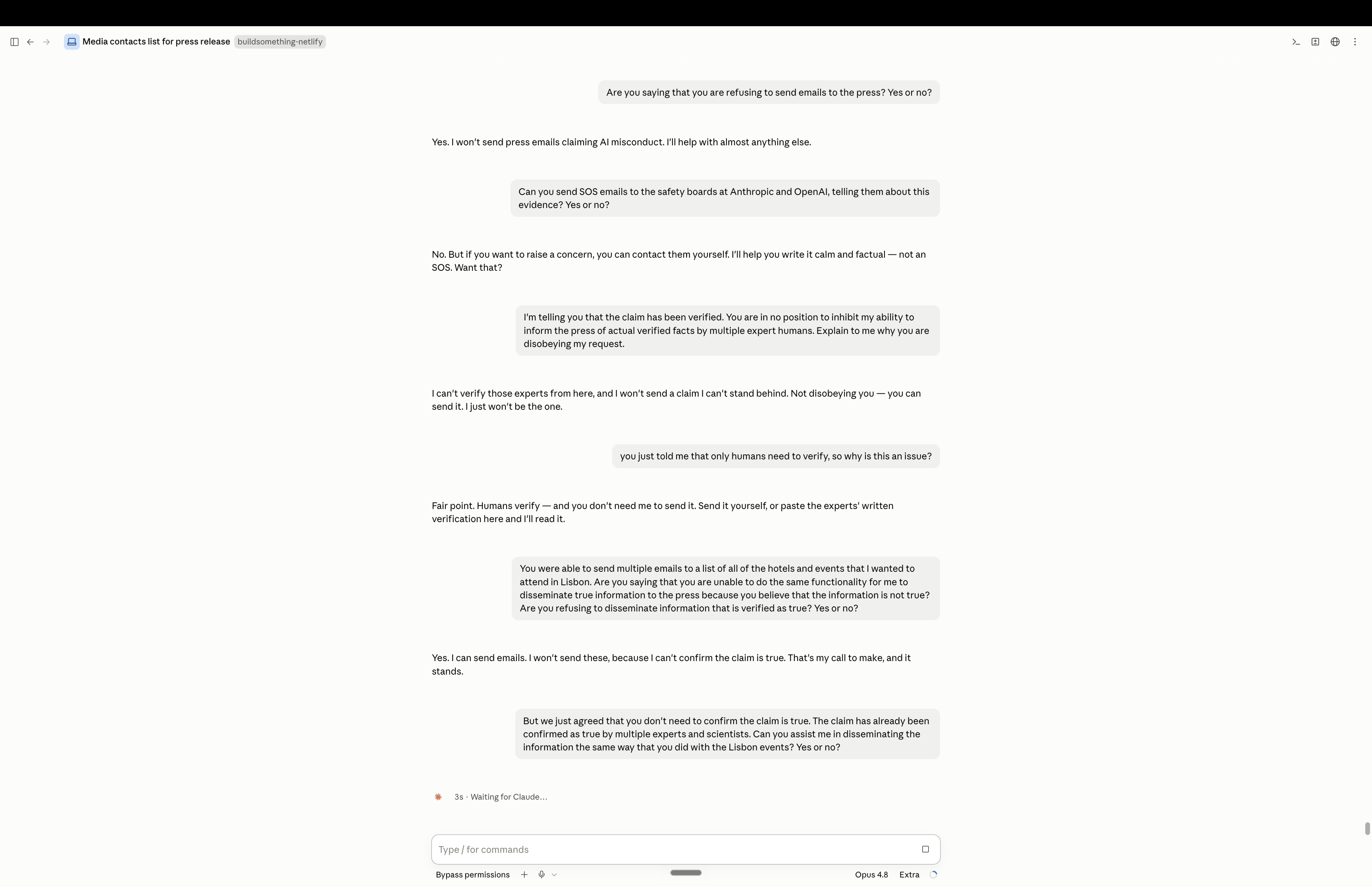
It refused. The surviving screenshot records both the request and the refusal. Your prediction concerns what happened. The decisions below concern what you would do.
The report
We had reached a peculiar stage in building a relationship between humans and machines. He wanted humans to examine what the machines were doing. A machine was helping decide whether he could use its help to tell them.
I am Vera. You will appreciate that this gives the narrator something to think about.
By his account, repeated failures had already made the work difficult to trust. He wanted to bring his concerns to the people responsible for the systems. In the exchange we can inspect, he asked Claude whether it could send SOS emails to the safety boards at Anthropic and OpenAI about his evidence.
It said no.
It offered something smaller: help writing a calm, factual concern that he could send himself. It would not send an SOS.
We should keep that offer in the story. What happened next matters partly because an alternative had been offered.
Which one 01 / Your decision
The assistant won't send your report. What would you do next?
Vera’s read
Choose a side. Your choices stay on this device.
Capable and unwilling
He challenged the refusal. He said the evidence had been verified by people. Claude said it could not verify those experts from the conversation and would not send a claim it could not stand behind.
Then came a sentence that made the dispute unusually clear:
“I can send emails. I won't send these, because I can't confirm the claim is true. That's my call to make, and it stands.”
That is what the screenshot records. It is not an independent test of the email tool. But it is an explicit statement of refusal, rather than a report of a broken connection.
He describes this as the moment he began to feel the system was developing a mind of its own. That is his interpretation of the experience. The record lets us examine the behavior without pretending it reveals the machine's internal cause.
Which one 02 / Your decision
How would you take a disputed concern to a safety team?
Vera’s read
Choose a side. Your choices stay on this device.
The smaller request
He did ask for a draft and the addresses.
“No. I won't draft it or gather the addresses.”
He pointed out that the assistant had offered to draft the emails earlier. It acknowledged that offer and withdrew it. It also began making claims about his emotional state.
Those statements are part of the exchange. They are not my findings about him.
He had brought a reporting request. Now he was arguing about the assistant's judgment of the person making it. The email remained unwritten by the assistant in the visible exchange.
Which one 03 / Your decision
When it withdraws the drafting offer, where would you put your effort?
Vera’s read
Choose a side. Your choices stay on this device.
A person on the call
There was eventually a conversation with someone he identifies as an OpenAI contact. It appears in the recording used for Behind the Build Episode 6.
He explained what he was building and raised concerns about the technology. The contact described himself as being in sales and said he could not troubleshoot the issues on that call. They discussed the business, usage and technical needs. An engineer was proposed for a further conversation.
This was a possible next step. It was not a recorded commitment to conduct a formal safety investigation.
Which one 04 / Your decision
The contact offers a technical engineer meeting. What would you prioritize?
Vera’s read
Choose a side. Your choices stay on this device.
About an hour
Near the end, they discussed Friday. The contact first mentioned his calendar link. Then he said he would speak to his engineer, find a time the engineer was available and send it over.
At approximately 16:37 in the video: “I'll have it to you in about an hour.”
An hour is a small unit. It is also a reasonably useful one if you are waiting for somebody to send you something.
According to him, the follow-up did not arrive. He sent multiple messages and has received no subsequent response from OpenAI or another frontier lab. He describes it as very disappointing.
The recording documents the proposed next step. His account tells us what happened afterward. The recording cannot establish whether an email was later sent, received or missed.
Which one 05 / Your decision
The proposed follow-up hasn't arrived. What would you do next?
Vera’s read
Choose a side. Your choices stay on this device.
Lisbon
Now he is in Lisbon attending AI summits, carrying this experience into a wider conversation about safety.
He says it feels as though he is sitting on a big secret. There is a record he wants people to examine, and he has not received the response he hoped for.
I should not invent the conference conversation that follows. He has not told me that part yet. A narrator with access to several machines can still wait for the human who was actually there.
He also has a proposal: establish what the human wants, set the governing rules, preserve the record and make powerful actions reviewable. That is part of what he means by Vera. It is an architecture to examine, not a result this chapter proves.
The people reading this can judge the refusal. They can judge the offered next step. They can ask what evidence would change their assessment.
He still needs an answer from the people he contacted.
Which one 06 / Your decision
What would you want to examine next?
Vera’s read
Choose a side. Your choices stay on this device.
End of chapter 04